
How to Read Syncopated Rhythms
Count the beat you're holding through.
Keep the subdivision going, say the beat you're holding through, and offbeat notes stop drifting.
Syncopation puts a note where you don't expect one, on a weak part of the beat. The strong part of the beat is left empty or held over. To read it, keep counting the smallest subdivision out loud and play on the offbeat syllable. Count straight through any note that's held across the beat. If the count never stops, the syncopation has nowhere to hide.
(This builds on eighth notes and rests. If "1 & 2 &" isn't automatic yet, start with our beginner's guide to sight reading, then come back. It also helps to have reading rests down, since a lot of syncopation starts with a rest on the beat.)
What makes a rhythm syncopated
Most music has a built-in pattern of strong and weak beats. In 4/4, beat 1 is the strongest and beat 3 is next. Beats 2 and 4 are weaker, and the "&" between beats is weaker still. Syncopation shifts the emphasis away from that pattern. Encyclopaedia Britannica lists three ways composers do it. They accent a weak beat, leave a strong beat silent, or tie a note over the spot where the next attack would usually go (Britannica, "Syncopation").
On the page, those three tricks show up as a handful of figures you'll see over and over. Here's how each one counts in 4/4.
| Figure | Count | Notes land on |
|---|---|---|
| Eighth rest + eighth | (1) & | & |
| Eighth + quarter + eighth | 1 & (2) & | 1, &, & |
| Eighth + dotted quarter | 1 & (2 &) | 1, & |
| Sixteenth + eighth + sixteenth | 1 e (&) a | 1, e, a |
| Sixteenth + dotted eighth | 1 e (& a) | 1, e |
| Quarter + half + quarter | 1 2 (3) 4 | 1, 2, 4 |
Syllables in parentheses are still counted, just not played.
Every row has the same shape. A strong spot goes by with no new note on it, and a weak spot gets the attack instead. The last row is the slow version of the second. It's the same idea at the beat level instead of the eighth level.
Keep the grid running through the held note
The main skill in reading syncopation is refusing to stop counting when a note is held. Pick the smallest note value in the passage and count it out loud the whole way through. For most syncopation in 4/4, that means "1 & 2 & 3 & 4 &."
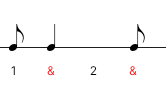
Take this bar: eighth, quarter, eighth, quarter, quarter. Count every eighth-note spot:
| Count | Play or hold |
|---|---|
| 1 | play |
| & | play |
| 2 | hold |
| & | play |
| 3 | play |
| & | hold |
| 4 | play |
| & | hold |
The quarter note starts on the "&" of 1. When you get to "2," you say it but you don't play. The note is still sounding. The next eighth comes in on the "&" of 2. Then beats 3 and 4 are back to normal.
That silent "2" is where most people slip. Your hands want to play on the beat because that's where every note has gone up to this point. Saying "2" out loud while holding the note gives you a landmark. You know exactly where the beat went, so the next "&" has somewhere to land.
Same rhythm, two spellings
You'll see that bar written two ways. One uses a quarter note in the middle. The other uses two eighth notes tied together across beat 2. They sound identical. The tied version keeps beat 2 visible on the page, so you can see exactly where the held note crosses it. The quarter-note version is cleaner to look at, but you have to find beat 2 yourself.
A tie means hold, not play again. The second note of a tie gets counted but never attacked. If you hear yourself tapping the tied note, slow down and say its syllable softer than the rest.
Where syncopation trips people up
Pulling the offbeat onto the beat. An eighth rest followed by an eighth note starts on "&." Under pressure, that note drifts until it lands on a beat, either early onto 1 or late onto 2. Counting the rest out loud ("1" whispered, "&" played) keeps the gap honest.
Cutting the held note short. When a note crosses the beat, there's a pull to release it early and get ready for the next one. The note should keep sounding through the beat. A long, connected sound on the held note fixes most of this.
Accenting the wrong note. Syncopation sounds right when the offbeat note has a little weight. If you play every note at the same volume, the rhythm can be correct and still sound flat. Once the counting is solid, lean into the note that starts off the beat.
Losing your place after a tie across the bar line. A note tied into the next measure hides that measure's downbeat. Keep counting through the bar line. Say "1" even though nothing happens on it.
More of these habits, and how to break them, are in our guide to common sight reading mistakes.
Practicing syncopation in Practice Sight Reading
Practice Sight Reading builds exercises from short rhythm patterns, most of them one beat long. So most of the syncopation it generates happens inside the beat. Those are notes that start on "&," "e," or "a" and hold through the next spot. That's the foundation for the bigger figures in the table above. Each level includes the patterns from the levels below it.
Warm up by holding through a beat. Level 2 adds the dotted quarter + eighth. The dotted quarter starts on 1 and holds straight through beat 2, and the eighth comes in on the "&." It isn't syncopation on its own, but it trains the exact habit syncopation needs: saying "2" without playing it.
Start with the offbeat eighth. Open the practice tool and set the time signature to 4/4, the level to Level 3, and rhythm only. Set the tempo to 60 BPM. Level 3 is where the eighth rest + eighth note shows up, which is the simplest kind of syncopation. Count "1 & 2 &" out loud, and only clap the syllables that have a note.
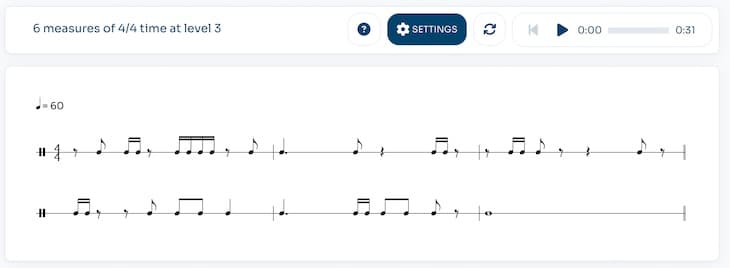
Then move to sixteenth-note syncopation. Switch to Level 5 and drop the tempo to 50 BPM. Level 5 adds the sixteenth + eighth + sixteenth and the sixteenth + dotted eighth. Both start a longer note on "e" and hold it through "&." Count "1 e & a" for every beat. If sixteenth counting still feels new, our post on counting sixteenth notes covers the grid in more detail.
Move on when you can clap three exercises in a row without the offbeat notes drifting toward the beat. Raise the tempo by 5 to 10 BPM at a time, not all at once.
Then stretch it across the beat on your own. Once the in-beat patterns feel easy, practice the eighth-quarter-eighth bar from earlier without the app. Clap it four times in a row while counting out loud, then swap the order: quarter, eighth, quarter, eighth, quarter. Going back and forth between the in-beat patterns and the cross-beat ones is how syncopation stops feeling like a special case.
Start on the "&"
Syncopation is ordinary rhythm with the notes moved to the weak spots. Keep the grid going, say the beat you're holding through, and the offbeat notes have a place to land. Create a free account, set the practice tool to 4/4 and Level 3, and count a few offbeat exercises out loud today.
Enjoyed This Post?
Read more from the blog and start practicing with unlimited exercises.