
Counting Sixteenth Notes: A Rhythm Reading Guide
Four spots in every beat: 1, e, &, a.
Count all four spots, play only the ones with notes, and sixteenth-note rhythms stop being guesswork.
In 4/4 time, you count sixteenth notes as "1 e & a, 2 e & a, 3 e & a, 4 e & a." The number lands on the beat. The "&" lands halfway through it. The "e" and "a" fill the two gaps in between. Every sixteenth-note rhythm you'll read in simple meter is some combination of those four spots. Once you can hear all four, you can count any pattern built from them.
(If quarter notes and eighth notes still feel shaky, start with our beginner's guide to sight reading first. Sixteenths get easier when the beat and the "&" are already automatic.)
Sixteenth notes were never hard for me to read. My problem was speed. I rushed. The fix was slowing down and giving the quarter and eighth notes their full length, so that when the sixteenths showed up, I could play them at the right speed instead of squeezing them in.
The four spots inside every beat
A quarter note gets one beat. Split that beat in half and you get two eighth notes. Split it in half again and you get four sixteenth notes. That's all a sixteenth is: one quarter of a beat.
Counting systems give each of those four spots a name. The one most band and piano students learn is "1 e & a," but it isn't the only option. Kodály classrooms often use "ti-ka-ti-ka," and the Takadimi system uses "ta-ka-di-mi" (Wikipedia, Counting (music)).
| Spot in the beat | 1 e & a | Takadimi | Kodály |
|---|---|---|---|
| On the beat | 1 (2, 3, 4) | ta | ti |
| First quarter past | e | ka | ka |
| Halfway | & | di | ti |
| Three quarters past | a | mi | ka |
Pick one system and stick with it. The syllables matter less than saying them out loud, evenly, every time. I'll use "1 e & a" for the rest of this guide.
Count all four spots, even when you only play some
Here's the idea that makes sixteenth rhythms manageable: keep counting all four syllables, and only play the notes on the syllables that have one. A longer note just covers more than one spot.
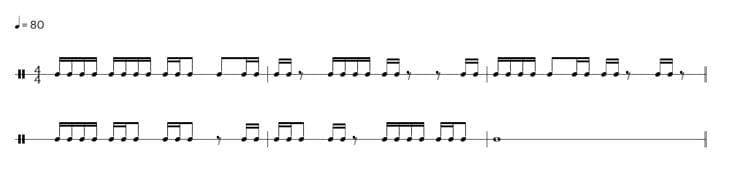
Take an eighth note followed by two sixteenths. The eighth note lasts two sixteenths' worth of time, so it covers "1" and "e." The two sixteenths land on "&" and "a." You say "1 e & a" and play on 1, &, and a.
| Pattern | Count | Notes land on |
|---|---|---|
| Four sixteenths | 1 e & a | 1, e, &, a |
| Eighth + two sixteenths | 1 (e) & a | 1, &, a |
| Two sixteenths + eighth | 1 e & (a) | 1, e, & |
| Dotted eighth + sixteenth | 1 (e &) a | 1, a |
| Sixteenth + dotted eighth | 1 e (& a) | 1, e |
| Sixteenth + eighth + sixteenth | 1 e (&) a | 1, e, a |
| Eighth rest + two sixteenths | (1 e) & a | &, a |
Syllables in parentheses are still counted, just not played.
This is also why Takadimi works the way it does. Its creators, Richard Hoffman, William Pelto, and John W. White, assigned syllables to positions within the beat rather than to note values (Hoffman, Pelto, and White, Journal of Music Theory Pedagogy, 1996). An eighth plus two sixteenths is "ta di mi." A dotted eighth plus sixteenth is "ta mi." Same principle, different syllables. The rhythm you hear always gets the same name, no matter how it's written.
Where sixteenths trip people up
Rushing the "a" into the next beat. The last sixteenth in a group wants to crowd the downbeat that follows it. Counting all four syllables out loud keeps the gap honest.
Turning a dotted eighth and sixteenth into a triplet. When the short note comes in too early, the pattern starts to swing. Band director Gabriel Fadale calls out this exact habit in The Instrumentalist. The fix is to hear the silent "e" and "&" before the sixteenth on "a." If you only feel two notes, it'll drift toward a triplet.
Losing the beat after a rest. An eighth rest followed by two sixteenths starts on "&," not on the beat. Count "1 e" silently, then play "& a." If you skip the silent part, the whole bar shifts.
Starting too fast. Sixteenths add up quickly. At 120 beats per minute, four sixteenths per beat is eight notes every second. Drop the tempo until every syllable is even, then speed up. More of these habits show up in our guide to common sight reading mistakes.
Practicing sixteenths in the order they get harder
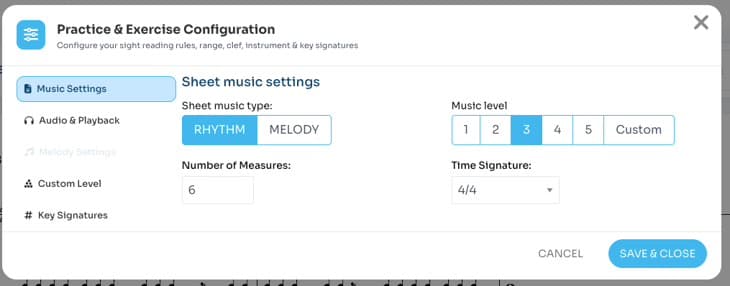
The rhythm levels in Practice Sight Reading bring in sixteenth patterns gradually, so you can match the level to what you're working on. Each level includes the patterns from the levels below it. In duple meters like 4/4:
- Level 3 introduces four sixteenths, eighth rest + two sixteenths, two sixteenths + eighth rest, and dotted quarter + two sixteenths.
- Level 4 adds eighth + two sixteenths and two sixteenths + eighth, along with triplets.
- Level 5 adds the dotted eighth + sixteenth (and its reverse), sixteenth + eighth + sixteenth, and patterns where single sixteenths sit next to sixteenth rests.
To start, open the practice tool and set the time signature to 4/4, the level to Level 3, and rhythm only. Set the tempo around 60 BPM. Read the first exercise once silently while counting, then play or clap it along with the audio. When you can get through three exercises in a row without stopping, move the tempo up or go to Level 4.
Sixteenths show up in 6/8 and other compound meters too, where six of them fill one dotted-quarter beat. Triple Level 3 is where those start.
Build a custom level around the pattern you keep missing
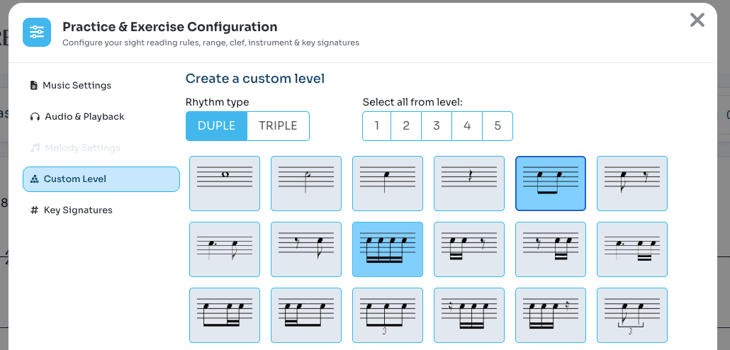
Levels mix a lot of patterns together. That's good for sight reading, but it isn't always the fastest way to fix one specific rhythm. Custom levels let you pick exactly which note groupings go into an exercise. Custom levels are part of the Deluxe plan.
A few pairings I'd work through in this order:
- Quarter notes + four sixteenths. The biggest contrast possible: one note per beat against four. This trains you to lock into the subdivision instantly.
- Eighth notes + four sixteenths. Now you're switching between two and four per beat, which is harder than it sounds at speed.
- Eighth + two sixteenths and two sixteenths + eighth. These two are mirror images. Mixing them forces you to know where the eighth sits instead of guessing.
- Dotted eighth + sixteenth and sixteenth + dotted eighth. This is the pair that fixes the triplet-swing habit. Keep the tempo low and count every syllable.
- Eighth rest + two sixteenths, plus quarter notes. Good for anyone who loses the beat after a rest.
Stay with one pairing until it feels boring. Then add a pattern from the next step.
To build one, open Settings, click the Custom Level tab, and select the rhythms you want to practice.
Start counting
Sixteenths stop being scary once you trust the grid: four spots per beat, all of them counted, some of them played. The rest is reps. Create a free account, set the practice tool to 4/4 and Level 3, and count "1 e & a" out loud through a few exercises today.
Enjoyed This Post?
Read more from the blog and start practicing with unlimited exercises.