
Reading Rests: Why Silence Is the Hardest Part of Sight Reading
Silence has a beat too. Here's how to count through it.
Notes tell you what to play. Rests tell you what not to play. Most musicians focus on the first part and gloss over the second. That's why rests cause more stumbles in sight reading than wrong notes do.
The problem isn't that rest symbols are hard to recognize. It's that your brain wants to stop counting when the sound stops. You see a rest, you relax for a beat, and then you guess when the next note starts. Guessing is where everything falls apart.
Rests are rhythmic events. They have exact durations, exact positions in the measure, and exact relationships to the notes around them. Reading them well means counting through them with the same attention you give to notes. If you're new to sight reading, our beginner's guide covers the fundamentals of rhythm-first practice. Rests are where that foundation gets tested.
What Each Rest Symbol Means
Every note value has a matching rest of the same duration. The symbols look different from notes, which can throw beginners off.
A whole rest hangs below a staff line and lasts four beats in 4/4 time. It fills an entire measure of silence. A half rest sits on top of a staff line and lasts two beats. The two look almost identical, just flipped, and confusing them is one of the most common notation-reading mistakes.
A quarter rest is the squiggly symbol that looks a bit like a lightning bolt or a stylized "7." It lasts one beat. You'll see these constantly from the very first exercises you read.
An eighth rest has a single flag and lasts half a beat. A sixteenth rest has two flags and lasts a quarter of a beat. As rests get shorter, their placement within the beat becomes more precise and more demanding to read.
These durations stay consistent no matter what time signature you're in. A quarter rest in 3/4 lasts one beat, same as in 4/4. An eighth rest in 6/8 lasts half of one eighth-note pulse. The symbol always means the same thing. Only the context changes.
Why Rests Are Harder Than Notes
When you play a note, you get feedback. You hear the pitch, feel the vibration, see your fingers move. Your body confirms you did something.
When you play a rest, nothing happens. No sound, no motion, no feedback. Your brain interprets this as "nothing is going on" and checks out. But the beat hasn't stopped. The measure is still moving. And the next note is approaching at the same tempo whether you're counting or not.
This is the core challenge: maintaining internal pulse through external silence.
The shorter the rest, the less time you have to drift. A whole rest gives you four beats to lose focus. An eighth rest on the "and" of beat two barely gives you time to blink. But the longer rests are actually harder in some ways, because you have to sustain your counting through more emptiness.
How Rests Build Through PSR's Levels
Practice Sight Reading introduces rests gradually across its difficulty levels. Each new type of rest adds a specific reading challenge.
Duple time (4/4, 3/4, 2/4)
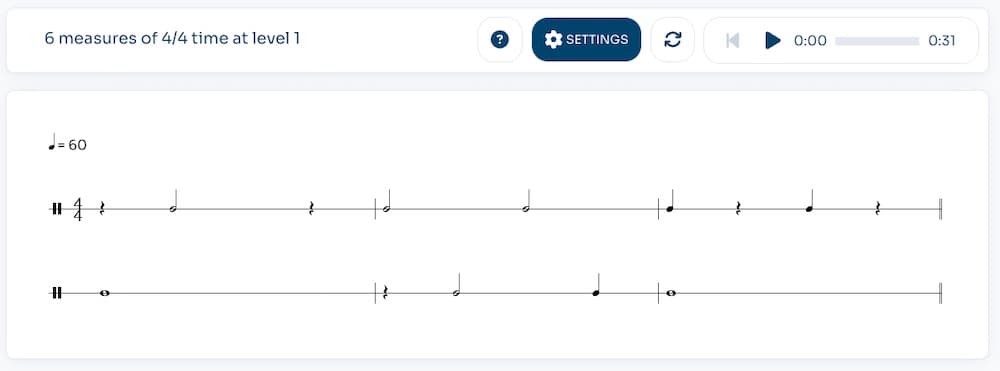
Level 1 includes the quarter rest. At this stage, rests fall on whole beats. You count "1, 2, rest, 4" or similar patterns. The challenge is keeping your count steady when a beat produces no sound.
Set Practice Sight Reading to 4/4 time, Level 1, rhythm only. Listen to how the audio playback handles the silence. The metronome pulse continues through the rest. Your counting should match that consistency.
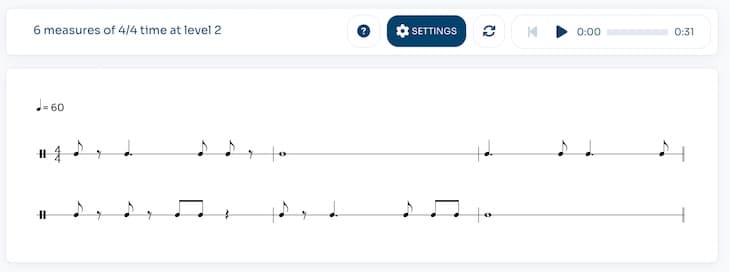
Level 2 adds the eighth note followed by an eighth rest. Now rests fall on the "and" of a beat instead of the beat itself. The note sounds on the downbeat, and the rest occupies the second half. This is your first encounter with a rest that doesn't land on a numbered count.
Count it: "1-and, 2-and" where the "and" after a note-rest pair is silent. Tap your foot on the downbeats. Your foot should still move during the rest.
Level 3 flips the pattern: eighth rest followed by eighth note. The rest is on the downbeat. The note is on the "and." This is where many musicians hit a wall.
When the rest falls on a beat you expect to hear a note, the whole pattern feels wrong. Your foot taps on silence, and the sound comes between taps. This is the beginning of offbeat playing, and it's one of the most useful skills you can develop as a reader. Stay on Level 3 until these patterns feel reliable before moving up.
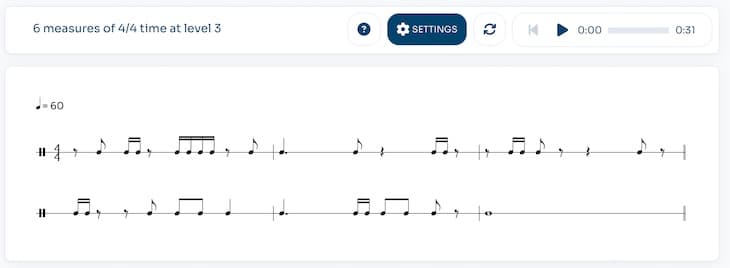
Level 5 scatters sixteenth rests across the beat. Patterns like a sixteenth rest followed by three sixteenth notes, or three sixteenths followed by a rest. At this level, rests last a quarter of a beat. Placing them accurately requires counting subdivisions: "1-e-and-a, 2-e-and-a." The rest might land on any one of those syllables.
Four Techniques for Counting Through Rests
1. Count out loud, whisper the rests
Count every beat and subdivision out loud. When you hit a rest, whisper or mouth the count instead of saying it: "ONE and TWO and three and FOUR and" (where the italicized count is whispered). This keeps your voice tracking the pulse even when no sound comes from your instrument. The whisper reminds your brain that the rest is a counted event, not a gap.
2. Tap your foot through everything
Your foot marks the pulse. It never stops for a rest. If you catch your foot pausing during a rest, that's your signal that you've stopped counting. The foot is your backup clock. When your brain checks out, your foot keeps the reference going.
3. Think the next note's entrance
During a rest, shift your attention forward. Where does the next note fall? On the beat? On the "and"? Anticipating the next entrance turns the rest into preparation instead of empty space. This is the same "look ahead" habit that makes all sight reading easier. (Skipping this step is one of the most common reading mistakes.)
4. Practice rests without your instrument first
Clap and count through exercises before you play them. When a rest comes up, keep your hands apart and count through it. If you can't clap a rhythm accurately, you can't play it accurately either. Removing the instrument takes away pitch distractions and lets you focus on the timing.
The Offbeat Rest Problem
The hardest rest pattern for most musicians is a rest on a strong beat followed by a note on a weak beat. In duple time, that looks like an eighth rest on the downbeat with an eighth note on the "and." In compound time, it's an eighth rest starting a three-note group.
These patterns create syncopation. The accent shifts from where your brain expects it to where the note actually is. It sounds intentionally off-balance, and it is. Jazz, funk, Latin music, and pop all rely on this tension. The groove lives in the gap between where you expect sound and where it lands.
PSR's Level 3 (duple) and Level 2 (triple) are where these offbeat patterns first appear. If they feel impossible at first, slow the tempo way down. Use the audio playback to hear the correct rhythm, then try to match it. Count through a few measures with just your voice before adding your instrument.
The trick is to never let the rest surprise you. You know it's coming because you read it. The count tells you exactly where the next note goes. Trust the count.
Silence Is Part of the Music
A rest isn't a gap in the rhythm. It's a note you don't play. It takes up space in the measure, carries rhythmic weight, and shapes the phrase. The composer put it there for a reason.
Musicians who read rests well sound more musical even when they play. Their phrases breathe. Their attacks land in the right places. The silence around their notes gives the notes meaning.
Create a free account and start with Level 1 in any time signature, rhythm only. Pay attention to where the rests fall. Count through them. That habit alone will change how you read everything else.
Enjoyed This Post?
Read more from the blog and start practicing with unlimited exercises.