
How to Count Triplets: Reading Three Against a Straight Beat
Keep the beat. Switch the subdivision.
A triplet puts three notes where two normally go. The hard part is switching between three and two without losing the beat.
A triplet squeezes three equal notes into the space where two normally go. An eighth-note triplet puts three notes in one beat instead of two. Count it "1-trip-let, 2-trip-let," keep the beat exactly where it was, and change only how you divide it.
That last part is where most people fall apart.
When I was in high school, I auditioned for an honor band. Along with the prepared pieces, there was a sight reading excerpt. That year it was built around triplets, mixed in with regular eighth notes. A lot of people failed it. Not weak players either. Some of the best musicians in the room got stuck on that excerpt. And if you failed the sight reading, you weren't selected. The band was worse for it. Plenty of good players sat that year out because of one rhythm.
I made it through. I can't remember why, or who taught me. But I knew how to switch between triplets and two eighth notes without losing the beat. That one skill was the difference.
(If eighth notes and basic counting still feel shaky, start with our beginner's guide. Triplets go much smoother once "1-and-2-and" is automatic.)
What a Triplet Is
A triplet is three notes played in the time of two notes of the same value. You'll see a small 3 over or under the group, usually with a bracket or a beam.
The most common one is the eighth-note triplet. Two eighth notes normally fill one beat in 4/4. Three triplet eighths fill that same beat. Each note is a third of a beat long.
The beat doesn't change. The tempo doesn't change. Only the subdivision changes, from two equal parts to three.
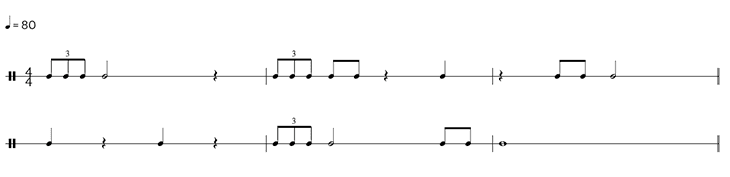
Ways to Count Triplets
Every counting system does the same job. It gives you three evenly spaced syllables per beat. Pick one and stick with it.
| System | One beat of eighth-note triplets |
|---|---|
| Number + "trip-let" | 1-trip-let |
| Number + syllables | 1-la-li or 1-tee-duh |
| Takadimi | ta-ki-da |
| Word method | pine-ap-ple, straw-ber-ry |
"1-trip-let" is the most common in school band rooms. The word method is a good backup if counting syllables feels abstract. "Pineapple" has three even syllables, and so does "strawberry." You can find more options in the Wikipedia overview of rhythm counting systems.
Takadimi uses "ta-ki-da" for any beat divided into three. That's handy, because it's the same syllables you'd use for the dotted-quarter beat in 6/8. More on that connection below.
The Real Skill: Switching Between Two and Three
Reading a whole measure of triplets isn't that hard. You lock into the three-feel and ride it. The hard part is what my audition excerpt tested: moving between triplets and straight eighths inside the same line.
Your brain sets up a grid for whatever subdivision it's been counting. Triplets shift that grid from two to three. Then the music switches back, and you have to shift again, on the beat, without warning.
Here's a way to build that switch before you read anything.
Step 1: Count the two grids out loud. Set a steady tempo and say "1-and-2-and-3-and-4-and." Then say "1-trip-let-2-trip-let-3-trip-let-4-trip-let." Your downbeats should land in exactly the same place both times.
Step 2: Alternate every beat. Say "1-and, 2-trip-let, 3-and, 4-trip-let." Tap your foot on every number. If your foot drifts, slow down.
Step 3: Clap it. Clap the syllables while you keep counting. The triplet claps should feel smooth and rolling. The eighth-note claps should feel even and square.
Once that alternating pattern feels boring, you're ready to read it.
Where Triplets Go Wrong
Lopsided triplets
The most common mistake is turning a triplet into something it's not. Players often play it as an eighth and two sixteenths, or two sixteenths and an eighth. It sounds close, but it's lumpy. All three notes should be the same length. Saying "pine-ap-ple" evenly out loud is a quick check.
Rushing into the next beat
Three notes feel busier than two, so people speed up. The triplet ends early and the next downbeat comes in too soon. Keep your foot tapping and make sure beat 2 arrives on time, not when the triplet finishes.
Straight eighths that start to swing
After a few triplets, the eighth notes that follow can pick up a lilt. Your ear is still in the three-grid. If "1-and" starts sounding like "1-(trip)-let," say the "and" louder and squarer for a few bars until it settles.
Losing the beat entirely
If you stop counting the numbers and only count syllables, you lose your anchor. The number is the beat. Everything else hangs off it. This is the same issue that shows up in other common sight reading mistakes: when the count goes, the rhythm goes with it.
Triplets in Practice Sight Reading
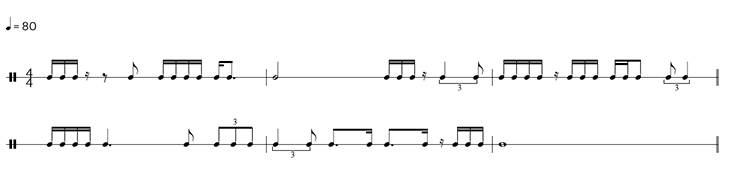
Eighth-note triplets first show up at Level 4 in duple time. They're mixed with sixteenth patterns and ties, so you'll get plenty of switching practice. To try it, open Practice Sight Reading, set the time signature to 4/4, choose Level 4, and select rhythm only. Slow the tempo down before you press play.
Level 5 adds two uneven triplet patterns: a triplet quarter followed by a triplet eighth, and the reverse. The quarter takes two-thirds of the beat. The eighth takes the last third. Count "1-trip-let" and hold through the "trip" for the long note.
If that long-short feel sounds familiar, it should. It's the same rhythm as a quarter followed by an eighth in 6/8. A triplet is basically one compound beat dropped into simple time. If you've worked through our compound time guide, you've already practiced this feel. If not, setting the time signature to 6/8, Level 1, rhythm only is a good warm-up before tackling Level 5 triplets.
A Three-Week Plan for Triplets
Week 1: Build the switch without notation. Five minutes a day of the counting drill above. Alternate "1-and" and "1-trip-let" every beat, then every two beats, then at random. Use the audio playback at a slow tempo as your steady pulse.
Week 2: Read Level 4. Set 4/4, Level 4, rhythm only. Before you play each exercise, scan it and circle the triplets in your head. Count the measure out loud once, then play it. Generate a new exercise every time. Repeating the same one turns it into memorization, not sight reading.
Week 3: Add Level 5 and push the tempo. Mix in Level 5 for the uneven triplets. Once Level 4 feels steady, raise the tempo a few clicks at a time. If you're getting fewer than about 80% of the rhythms right on the first read, drop back down. The 80% rule applies here like anywhere else.
Your counting should also cover the sixteenth notes that sit next to triplets at these levels. If "1-e-and-a" isn't solid yet, our guide to counting sixteenth notes is a good companion read.
The Rhythm That Shows Up in Auditions
I still think about that honor band. The people who didn't make it weren't missing talent. They were missing one specific rhythm skill that nobody had made them practice. Triplets show up in auditions because they expose whether you're counting or guessing. If you have an audition coming up, our guide to sight reading for auditions covers the rest of the prep.
The fix isn't complicated. Keep the beat where it is. Switch the subdivision. Practice the switch until it's boring.
Create a free account, set it to 4/4 Level 4, rhythm only, and try a few exercises. The triplets will find you fast.
Enjoyed This Post?
Read more from the blog and start practicing with unlimited exercises.