
Getting Comfortable Reading in Compound Time
3/8, 6/8, 9/8, 12/8
You read 4/4 just fine. Quarter notes, eighth notes, syncopation, no problem. Then you flip the page, see 6/8 at the top, and suddenly your counting falls apart.
The issue isn't that compound time is harder. It's that your brain has been trained to feel beats in groups of two, and now it needs to feel them in groups of three. That's a different motor pattern, not a harder one. But it does take deliberate practice to retrain. The same kind of practice that builds sight reading skill in general. (If simple time signatures like 4/4 still feel shaky, start with our beginner's guide before tackling compound meter.)
What actually changes in compound time
In 4/4 (and other "simple" time signatures like 2/4 and 3/4), each beat divides into two equal parts. A quarter note splits into two eighth notes. Your foot taps on the beat, and the subdivision falls neatly halfway between taps.
In compound time, each beat divides into three equal parts. In 6/8, you have two big beats per measure, and each one splits into three eighth notes. Your foot still taps on the beat, but now there are three subdivisions between taps instead of two.
Two big beats, each made of three smaller pulses. Once you internalize that feel, compound time stops being confusing and starts being fun.
6/8 is not 3/4
This trips up a lot of musicians. Both 6/8 and 3/4 contain six eighth notes per measure. But they feel completely different because of where the strong beats fall.
In 3/4, you feel three beats per measure. Each beat is a quarter note that divides into two eighths. Think of a waltz: ONE two three, ONE two three.
In 6/8, you feel two beats per measure. Each beat is a dotted quarter note that divides into three eighths. Think of a jig: ONE two three FOUR five six.
The difference shows up in how the music is beamed. In 6/8, eighth notes are grouped in threes. In 3/4, they're grouped in twos. When you see those beaming patterns on the page, they're telling you where the beats are.
How to count in 6/8
Start by counting all six eighth notes: 1 2 3 4 5 6. Give a strong accent to 1 and 4. Those are your two big beats.
Once that feels comfortable, shift to a two-beat count with subdivisions: ONE-and-a TWO-and-a. This is how experienced musicians internalize compound time. You feel two beats, and the "and-a" fills in the three-part subdivision.
Practice this away from your instrument first. Set a metronome to a slow tempo (around 50-60 BPM for the big beat, which means the dotted quarter = 50-60). Clap on beats 1 and 4 while counting the subdivisions out loud. Do this until the grouping-of-three pattern feels natural and you stop wanting to put a strong beat on beat 3.
A practice progression from duple to compound
The biggest mistake musicians make when learning compound time is jumping straight into complex rhythms. Just like you didn't start 4/4 with syncopated sixteenth notes, you shouldn't start 6/8 there either.
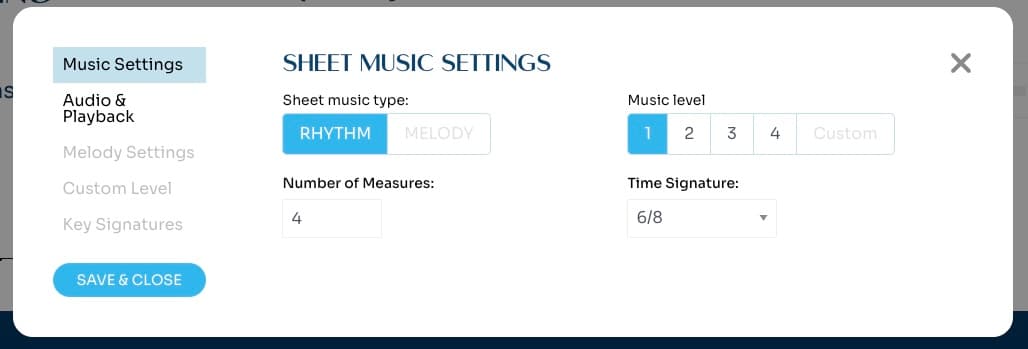
Here's a level-by-level progression. On Practice Sight Reading, set the time signature to 6/8 and start at Level 1 with only rhythm. These levels are all free.
Level 1: The building blocks
These are the patterns that teach your brain how compound beats work:
- Dotted half note fills the entire measure (both beats). This is your "whole note equivalent" in compound time.
- Dotted quarter note fills one beat. This is the fundamental unit. Get comfortable seeing a dotted quarter as "one beat" because in compound time, it is.
- Three eighth notes subdivide one beat into three equal parts. This is the compound subdivision in its purest form.
- Eighth + quarter (short-long) and quarter + eighth (long-short) within a single beat. These teach you to feel uneven subdivisions inside the compound beat.
- Dotted quarter rest is a full beat of silence. Keeping count through a rest is where your internal pulse gets tested.
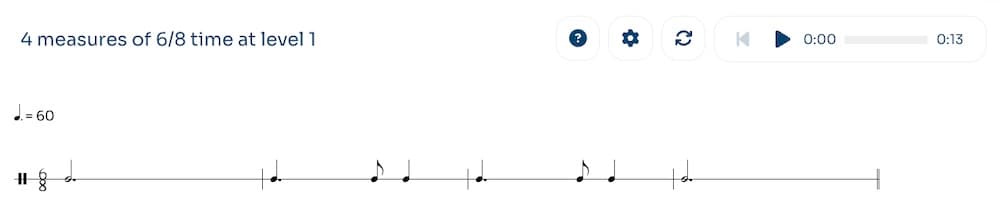
Practice tip: Set the tempo to 60 BPM (for the dotted quarter beat) and clap through these exercises. Don't play your instrument yet. Rhythm first, always. When you can clap through Level 1 exercises without losing the beat, you're ready to play them on a single pitch. When that's comfortable, move to Level 2.
Level 2: Rests and offbeats
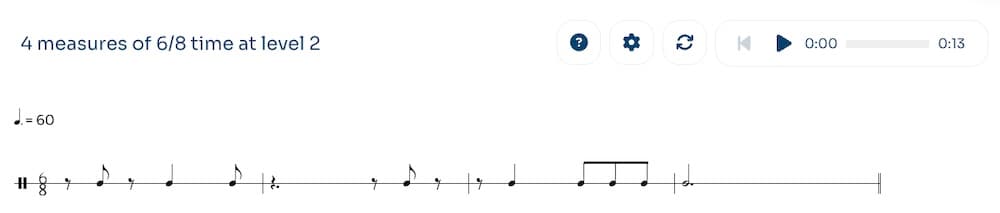
Level 2 adds rests inside the beat, which is where compound time starts to feel genuinely different from duple.
New patterns at this level include:
- Eighth rest + two eighths (silence on the downbeat of a subdivision group)
- Quarter rest + eighth note (two-thirds silence, then the note hits on the last subdivision)
- Eighth rest + quarter note (silence on the subdivision downbeat, then a longer note)
- Two eighths + eighth rest (the beat starts but the last subdivision is silent)
- Eighth + rest + eighth (notes on the outer edges of the beat, silence in the middle)
These patterns force you to maintain the three-part subdivision feel even when notes aren't filling every slot. This is the real test. If you lose the pulse during rests, slow the tempo down and count the subdivisions out loud: "ONE-and-a TWO-and-a." Every rest occupies a specific spot in that count.
Level 3: Sixteenth notes in compound time
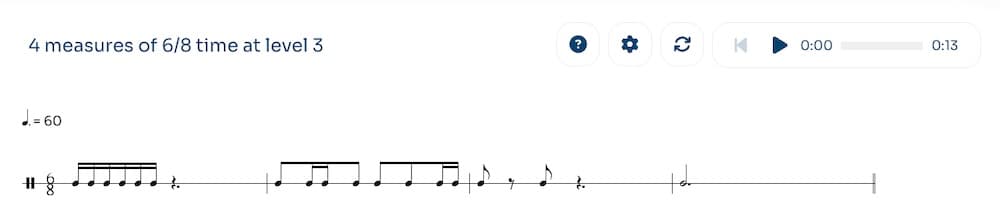
Sixteenth notes in compound time work differently than in 4/4. In simple time, four sixteenths fill one quarter-note beat. In compound time, six sixteenths fill one dotted-quarter beat (because the beat itself is three eighths long, and each eighth splits into two sixteenths).
Level 3 patterns include:
- Six sixteenth notes per beat (the full subdivision, like running sixteenths in duple but across a compound beat)
- Two sixteenths + two eighths (fast-fast then even, within one beat)
- Two eighths + two sixteenths (even then fast-fast)
- Eighth + two sixteenths + eighth (even, fast-fast, even)
The key to reading these is to keep feeling the big compound beat underneath. Count "ONE-and-a TWO-and-a" and layer the sixteenths on top. If you try to count every sixteenth individually, you'll get lost.
Level 4: Advanced compound rhythms
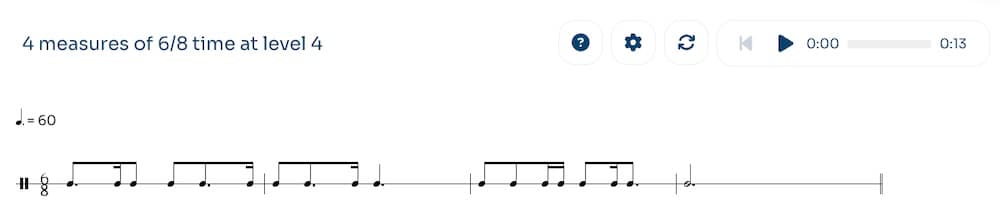
Level 4 introduces dotted-eighth and sixteenth-note combinations that create syncopated, uneven patterns within the compound beat:
- Dotted eighth + sixteenth + eighth
- Eighth + sixteenth + dotted eighth
- Sixteenth + dotted eighth + eighth
- Eighth + dotted eighth + sixteenth
These patterns are the compound-time equivalent of the dotted-eighth-sixteenth figures that trip people up in 4/4. They shift the emphasis within the beat and require you to really hear the subdivision grid.
If you're struggling at this level, go back to Level 2 for a few exercises before attempting Level 4 again. The fundamentals need to be automatic before the advanced patterns will click.
Common stumbling points
These are the compound-time versions of mistakes that slow down any sight reader. See our guide to common sight reading mistakes for the general list.
Counting six beats instead of two
The most common mistake. If you're counting "1, 2, 3, 4, 5, 6" with equal emphasis on every number, you're treating each eighth note as a separate beat. In 6/8, beats 1 and 4 are strong. The rest are subdivisions. Tap your foot on 1 and 4 only. If your foot is tapping six times per measure, that's the problem.
Confusing 6/8 with 3/4
Look at how the eighth notes are beamed. In 6/8, you'll see groups of three eighths beamed together. In 3/4, you'll see groups of two. The beaming is a visual cue that tells you where the beats are. Trust it.
Rushing the third subdivision
The triplet feel has a natural pull toward acceleration. Your brain wants to rush that third eighth note and land on the next beat early. Use a metronome. Not optional. Play at a tempo where you can comfortably fit all three subdivisions evenly, even if that tempo feels absurdly slow at first.
Dotted quarter notes feel like the wrong length
In 4/4, a dotted quarter spans a beat and a half. In 6/8, a dotted quarter is exactly one beat. This is one of those things that just needs repetition to rewire. Spend extra time at Level 1 until the dotted quarter feels like a natural single beat.
Losing your place during rests
Rests in compound time are where most people fall apart. You have to maintain the three-part subdivision internally even when nothing is sounding. Counting out loud fixes this. "ONE-and-a TWO-and-a" during rests until the internal pulse is strong enough to survive silence.
Beyond 6/8: other compound meters
Once you're comfortable in 6/8, the other compound time signatures follow the same logic. The difference is how many big beats per measure:
3/8 has one big beat per measure, subdivided into three eighth notes. It shows up in fast dance music and scherzos. It moves quickly and can feel like a single pulse per bar.
9/8 has three big beats, each subdivided into three eighths. Think of it as the compound version of 3/4. It has a waltz-like quality but with the rolling triplet subdivision. The "Ride of the Valkyries" feel.
12/8 has four big beats, each subdivided into three eighths. This is the compound version of 4/4. Blues shuffles and slow rock ballads live here. If you've ever heard a 12/8 blues, you already know what compound quadruple meter sounds like.
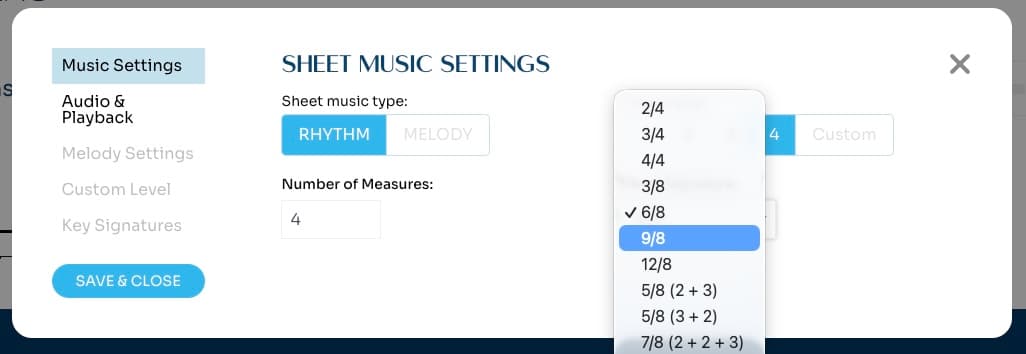
On Practice Sight Reading, all four compound time signatures (3/8, 6/8, 9/8, and 12/8) are available. The same triple rhythm levels apply across all of them, so once you've worked through the progression in 6/8, try the same levels in 9/8 or 12/8. The patterns are the same. Only the number of beats per measure changes.
Practice compound rhythms on Practice Sight Reading
The hardest part of learning compound time isn't understanding it. It's getting enough repetitions to make it feel natural. That takes a lot of exercises, and you can't repeat the same ones or you'll just memorize them instead of reading them.
Practice Sight Reading generates unlimited, randomized rhythm exercises in any compound time signature, with four progressive difficulty levels. Every exercise is different, so you're always reading fresh material. Set the time signature, pick your level, and hit refresh as many times as you need.
All of the rhythm exercises, including compound time, are free. Create an account and start practicing.
Enjoyed This Post?
Read more from the blog and start practicing with unlimited exercises.