
How to Count Dotted Rhythms: Dotted Quarter Notes, Dotted Eighths, and More
A dot adds half a note's value. Counting it in real time is the hard part.
A dot after a note makes it last longer. That much is simple. What's not simple is feeling that extra length while you're reading music in real time.
Dotted rhythms break the clean subdivision of the beat. Instead of notes that land on predictable count points, you get notes that stretch past the next subdivision. The following note gets pushed to an unexpected place.
This is why the dotted quarter note followed by an eighth note is one of the most commonly botched rhythms in music education. The math says the dotted quarter lasts one and a half beats. But knowing that and actually placing the eighth note in the right spot while sight reading are two different skills.
If you're still building comfort with basic quarter and eighth note rhythms, start with our beginner's guide and work through Level 1 exercises first. Dotted rhythms show up at Level 2 in Practice Sight Reading, and they go smoother when the basics are solid.
What the Dot Does
A dot adds half the original note's value. That's the rule, and it applies to every note and rest in music.
A dotted half note lasts three beats (2 + 1). A half note is two beats. Half of two is one. Add them together: three.
A dotted quarter note lasts one and a half beats (1 + ½). A quarter note is one beat. Half of one is half a beat. Add them: one and a half.
A dotted eighth note lasts three-quarters of a beat (½ + ¼). An eighth note is half a beat. Half of that is a quarter beat. Add them: three-quarters.
The pattern holds for dotted rests too. A dotted quarter rest is one and a half beats of silence.
The math is clean. The reading challenge is that these durations don't line up with the subdivisions you're used to counting. A dotted quarter stretches past the "and" of the beat and lands partway into the next one. That's the part you have to learn to feel.
The Dotted Quarter Note: Where Most Musicians Struggle
The dotted quarter followed by an eighth note is probably the single most important dotted rhythm to master. You'll see it constantly in marches, hymns, folk songs, and pop ballads. "Ode to Joy" uses it. So does almost every piece of music in 6/8 time.
In simple time (4/4, 3/4, 2/4)
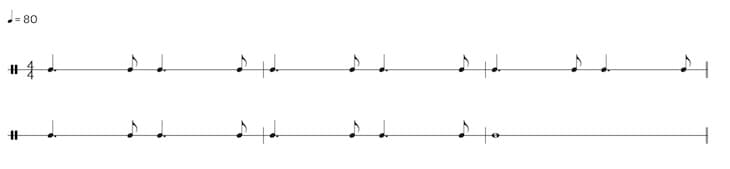
In 4/4, a dotted quarter on beat 1 lasts through the "and" of beat 1 and into beat 2. The eighth note that follows lands on the "and" of beat 2.
Count it by subdividing into eighth notes: "1-and-2-and." The dotted quarter occupies "1," "and," and "2." The eighth note falls on "and" (after 2).
Or think of it this way: the dotted quarter eats three eighth notes. The following eighth note is the fourth. Together they fill two full beats.
The common mistake is cutting the dotted quarter short and placing the eighth note too early. This usually happens because the musician isn't subdividing. If you count only the beats ("1, 2, 3, 4") without the "ands," you lose track of where the eighth note belongs. Counting the subdivisions ("1-and-2-and") gives you that reference.
In compound time (3/8, 6/8, 9/8, 12/8)
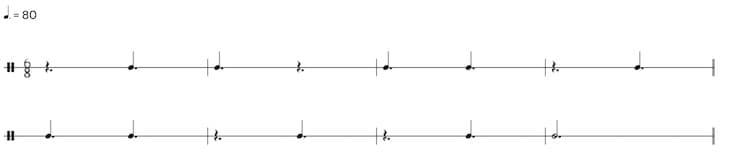
Here the dotted quarter note is the beat itself. In 6/8, each measure has two beats, and each beat is a dotted quarter. The dotted quarter divides into three eighth notes: "1-and-a" or "1-la-li." (For more on how compound meters work, see our compound time guide.)
This is the same note value, but it feels completely different. In simple time, the dotted quarter stretches awkwardly past a subdivision. In compound time, it is the natural pulse. This is why 6/8 music feels so smooth. The dotted quarter isn't fighting the beat. It is the beat.
Practice Sight Reading supports 6/8, 9/8, and 12/8, and at Level 1 in triple/compound time, the dotted quarter is one of the first note values you'll see. Set the time signature to 6/8, Level 1, rhythm only to practice feeling the dotted quarter as the natural compound beat.
Counting the Dotted Quarter-Eighth Pattern in Simple Time
This is the pattern that deserves the most practice. Here's a step-by-step approach:
Step 1: Count eighth-note subdivisions out loud. Set Practice Sight Reading to 4/4, Level 2, rhythm only. Before you play anything, count "1-and-2-and-3-and-4-and" along with the audio at a slow tempo. Get the subdivisions in your voice and your body.
Step 2: Identify where the dotted quarter-eighth pattern appears. In a Level 2 exercise, you'll see the dotted quarter tied to the next beat position. The eighth note follows on the "and." Scan the measure before you play it. Find the dotted quarters.
Step 3: Tap and count. Tap the rhythm on a table or your knee while counting the subdivisions out loud. The dotted quarter gets "1-and-2." The eighth note gets "and." Don't play your instrument yet. Let the counting pattern become automatic first.
Step 4: Play at a slow tempo. Once the tapping feels natural, play the exercise on your instrument. Keep the tempo slow enough that you never have to guess where the eighth note falls.
The Dotted Eighth-Sixteenth Pattern
The dotted eighth followed by a sixteenth note is a shorter, snappier version of the same idea. Instead of a long-short pattern spanning two beats, it fits inside a single beat. The dotted eighth takes three-quarters of the beat. The sixteenth takes the last quarter.
Count it using sixteenth-note subdivisions: "1-e-and-a." The dotted eighth occupies "1," "e," and "and." The sixteenth note falls on "a."
This pattern sounds crisp and march-like. You hear it in overtures, military music, and any style that wants a precise, clipped rhythmic feel. The reverse pattern (sixteenth then dotted eighth) sounds different. It has a quick pickup into a longer note. Both appear in Practice Sight Reading at Level 5 in duple time.
The counting approach is the same as for the dotted quarter-eighth: subdivide. If you count "1-e-and-a" on every beat, you always know exactly where the sixteenth note goes. Without that subdivision, you're guessing. And as with other common sight reading mistakes, guessing leads to inconsistent rhythm.

The Dotted Half Note
The dotted half note is the easiest dotted rhythm to read. It fills exactly three beats in 4/4 time, which means it sits on clean beat boundaries.
In 4/4, a dotted half note on beat 1 fills beats 1, 2, and 3. The next event (a note or rest) falls on beat 4. No awkward subdivisions. Just hold for three and move on.
In 3/4 time, a dotted half note fills the entire measure. It functions like a whole note in 4/4.
In compound time, the dotted half gets its own special role. In 6/8, a dotted half note fills the whole measure (all six eighth notes). You'll see this at Level 1 in triple/compound time in Practice Sight Reading, labeled as the dotted half.
Because the dotted half lands on beat boundaries, it rarely causes reading problems. If you can count to three, you can read a dotted half.
Why the Same Dot Feels Different in Simple vs. Compound Time
This is a concept that confuses a lot of musicians, but it's worth understanding because it changes how you practice.
In simple time (4/4, 3/4, 2/4), the beat is an undotted note. The quarter note is the beat. Dotted notes stretch past the beat boundary, which makes them feel syncopated or uneven. The dot creates tension against the underlying pulse.
In compound time (6/8, 9/8, 12/8), the beat is a dotted note. The dotted quarter is the beat. Undotted notes subdivide it. The dot doesn't create tension. It is the pulse. Three eighth notes fill each dotted quarter naturally.
The same dotted quarter note is a slightly uncomfortable rhythm in 4/4 but feels natural in 6/8. When you practice in compound time, don't think of the dotted quarter as "a quarter note plus something." Think of it as one beat that happens to divide into three.
Practice Sight Reading makes it easy to switch between simple and compound time signatures. Try the same level in 4/4 and then 6/8 to feel the difference. The dotted quarter appears in both, but the experience of reading it changes.
Practice Plan for Dotted Rhythms
Week 1: Dotted quarter-eighth in simple time. Use 4/4, Level 2, rhythm only. Count "1-and-2-and" on every beat. Focus on placing the eighth note after the dotted quarter on the correct "and." Generate several exercises per session. Ten minutes a day.
Week 2: Dotted quarter as the compound beat. Switch to 6/8, Level 1, rhythm only. Feel the dotted quarter as the pulse, not as an extension. Count "1-and-a, 2-and-a" for the compound subdivisions. Notice how the dotted quarter no longer feels awkward when it matches the meter.
Week 3: Mix simple and compound. Alternate between 4/4 Level 2 and 6/8 Level 1 within the same practice session. This builds flexibility. The dotted quarter is the same symbol, but your counting approach changes with the time signature.
Week 4: Dotted eighth-sixteenth (advanced). Move to 4/4, Level 5, rhythm only. The dotted eighth-sixteenth pattern is faster and demands sixteenth-note subdivisions. Count "1-e-and-a" on every beat. This is harder than the dotted quarter-eighth, so slow the tempo down from where you practiced at Level 2.
Ongoing: As you progress through levels, dotted rhythms combine with rests, ties, and syncopation. Each combination adds complexity, but the fundamental technique stays the same: subdivide the beat, and place each note on its correct subdivision.
The Dot Is a Shortcut, Not a Mystery
Composers use dots because writing a tie every time they want a note to last one and a half beats would clutter the page. The dot is shorthand. It means "hold this note for its value plus half more."
Once you internalize the subdivision counting, dotted rhythms stop being a special category. They become just another placement within the beat grid you're already tracking. The grid is the key. Subdivide, count, and place the notes where they belong.
Create a free account and try Level 2 in 4/4 or Level 1 in 6/8, rhythm only. The dotted quarter-eighth pattern will show up in your first few exercises. Count the "ands," and it clicks.
Enjoyed This Post?
Read more from the blog and start practicing with unlimited exercises.