
How to Read Bass Clef When You Already Read Treble Clef
Same staff, same letters. Only the landmarks change.
If you read treble clef, you already know most of bass clef. The shift is small, and there's a faster way to read than translating.
If you read treble clef, you already know most of bass clef. It's the same five-line staff, the same seven letter names, and the same rhythms. The only thing that changes is which letter sits on which line. Every bass clef note is two letter names higher than the treble clef note in the same spot. The bottom line is E in treble and G in bass.
That shift is the fastest way in. It's also the habit you need to drop as soon as you can, because sight reading doesn't leave you time to translate. Use the shift on day one. After that, read from landmarks.
(Still shaky on treble clef or rhythm reading? Start with our beginner's guide to sight reading and come back here after.)
What the bass clef symbol tells you
The bass clef is also called the F clef. The symbol started out as a stylized letter F. Its two dots sit on either side of the fourth line from the bottom. That line is F, specifically the F below middle C (F3).
This matters more than it looks. The clef isn't decoration. It's a pointer. Find the dots and you've found F without counting anything.
Treble clef works the same way. Its curl wraps around the second line, which is G. So each clef hands you one free note before you read a single bar.
The notes on the bass staff
Here are the lines and spaces from bottom to top:
| Position | Note | Mnemonic |
|---|---|---|
| Lines | G, B, D, F, A | Good Boys Do Fine Always |
| Spaces | A, C, E, G | All Cows Eat Grass |
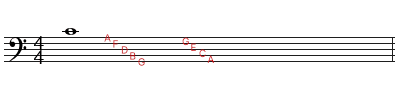
Learn the mnemonics if they help, but don't lean on them. A mnemonic gives you a list. It doesn't tell you where a note is relative to the one before it, and that's what you need while you're playing.
The two-letter shift (your training wheels)
Compare the two staves line by line and the pattern is easy to spot:
| Staff position | Treble clef | Bass clef |
|---|---|---|
| Bottom line | E | G |
| Bottom space | F | A |
| Middle line | B | D |
| Fourth line | D | F |
| Top line | F | A |
Same spot, two letters up. The pitch is also much lower. The bass note sounds almost two octaves below the treble note in the same position. All About Music Theory describes it as adding two letters, then dropping two octaves.
The shift is good for checking yourself. It's bad for reading in real time. Every note costs you a small calculation, and those calculations add up fast once the tempo starts. That's the same reason sight reading builds on recognition, not decoding.
Reading from landmarks instead
Landmark reading means memorizing a few notes so well you don't think about them. Every other note is then a step or two away from one of them. Piano teachers call these guide notes or anchor notes. Hoffman Academy teaches a set like this for the bass staff.
Start with four:
- Low G: the bottom line (G2)
- Bass C: the second space (C3)
- Bass F: the fourth line, between the clef's dots (F3)
- Middle C: one ledger line above the staff (C4)
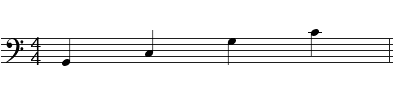
Now read by distance. A note on the line just above bass C is D. A note one space below bass F is E. A note sitting a line above the top of the staff is middle C, and the space right under it is B.
Middle C is the most useful of the four. It's where the bass and treble staves meet, sitting one ledger line above bass clef and one below treble clef. If you read both clefs, it ties them together.
Common bass clef mistakes
Reading everything a third off. This is the classic one. Your eyes default to treble clef and every note comes out two letters too low. G gets read as E, A as F, and so on. If a passage sounds wrong in a consistent way, check the clef. Then reset from the nearest landmark.
Counting up from the bottom line every time. It works, but it's slow. If you're counting G, A, B, C, D to find a note on the middle line, that's a sign you need landmarks. Count from the closest one instead.
Freezing on ledger lines above the staff. Trombone, cello, and bassoon parts climb above the staff often. Middle C, then D in the space above it, then E on the second ledger line. Treat middle C as a landmark and the ledger notes become one or two steps up.
Forgetting the rhythm while you think about pitch. Rhythm doesn't change between clefs. A dotted quarter is a dotted quarter (if that one still trips you up, see how to count dotted rhythms). But when note names take more effort, the counting is usually the first thing to slip. Keep the pulse going even if a note comes out wrong. Our guide to common sight reading mistakes covers why stopping to fix notes hurts more than the wrong note.
A practice plan that builds real fluency
Reading bass clef fast comes from volume. You need a lot of short, unfamiliar passages, read once, at a steady tempo. Reading the same piece over and over trains your memory, not your reading.
A simple progression:
- Week one: landmarks only. Keep the range narrow, low G up to bass F. Name each note out loud before you play it.
- Week two: the full staff. Open the range to the whole staff, low G to the top-line A. Stop naming notes out loud and just play.
- Week three: ledger lines. Extend the range up to middle C and the notes just above it. If your instrument lives lower, extend below the staff instead.
Keep each session to 10 or 15 minutes. Short and daily beats long and weekly.
Practicing bass clef in Practice Sight Reading
Reading pitch means practicing with melodies, not just rhythms. In Practice Sight Reading, melody exercises are part of Deluxe. They generate unlimited new bass clef passages, so you never read the same one twice.
To set up week one, go to /practice, open the settings, and choose:
- Sheet music type: Melody
- Clef (on the Clef and Largest Interval tab): Bass
- Key signature: C major (no sharps or flats)
- Note range (set with the arrow buttons for the lowest and highest note): lowest G, highest F, matching the landmarks above
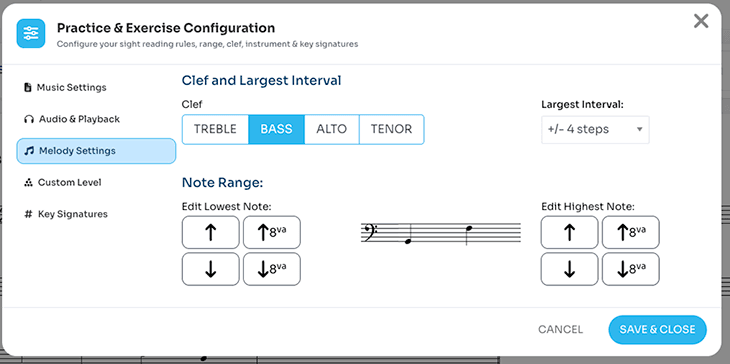
Widen the note range each week as the plan above describes. Once the full staff feels easy, try adding a key signature with one flat or one sharp.
You can also start for free. Create a free account and complete five rhythm exercises. That unlocks three free melody exercises with every melody setting, no credit card needed. It's enough to try a bass clef session before you decide anything.
Create your free account and start with rhythm. The bass clef part comes right after.
Enjoyed This Post?
Read more from the blog and start practicing with unlimited exercises.