
How to Read Alto and Tenor Clef
One symbol, two positions. Find middle C and the rest follows.
Alto and tenor clef are the same C clef in two positions. Find middle C, learn three landmarks per clef, and read the rest by distance.
Alto clef and tenor clef are the same symbol. The only difference is where it sits on the staff. In both clefs, the center of the symbol points to middle C. Alto clef puts middle C on the third line. Tenor clef puts it on the fourth line. Once you can spot that, you can read either one.
This guide assumes you already read treble or bass clef. (If you're still building that foundation, start with our beginner's guide to sight reading or how to read bass clef first.)
Who reads these clefs
Alto clef is the viola's home clef. It also shows up for alto trombone and a handful of early instruments like the viola da gamba (Wikipedia: Clef).
Tenor clef is a part-time clef. Cello, bassoon, trombone, euphonium, and sometimes double bass read bass clef most of the time, then switch to tenor clef when the part climbs. The point is to avoid stacks of ledger lines above the bass staff. If you play one of those instruments, you won't live in tenor clef. You'll move in and out of it, sometimes in the middle of a line.
That matters for how you practice. A violist needs alto clef to feel like home. A cellist needs the switch between bass and tenor to feel like nothing.
The C clef points at middle C
The symbol looks a bit like a stylized B or a 3 with a bracket. Look for the spot where its two curves meet in the middle. That line is middle C (C4).
| Clef | Middle C sits on | Bottom line | Top line |
|---|---|---|---|
| Alto | 3rd line (the middle) | F3 | G4 |
| Tenor | 4th line (second from top) | D3 | E4 |
Because the symbol is identical, the most common mistake with C clefs is reading one as the other. Before you read a single note, check which line the clef is centered on. It takes half a second and saves a whole passage of wrong notes.
The notes on the alto staff
Lines, bottom to top: F, A, C, E, G
Spaces, bottom to top: G, B, D, F
Treble clef readers will notice something. The alto lines spell FACE, then G. That's the same word treble readers learned for the treble spaces, just moved onto the lines with a G on top.
The notes on the tenor staff
Lines, bottom to top: D, F, A, C, E
Spaces, bottom to top: E, G, B, D
FACE shows up again. This time it's on the top four lines, with D underneath. Alto is FACE plus G on top. Tenor is D plus FACE. Same word, shifted down one line.
The one-letter shift from treble clef
If you read treble clef, there's a shortcut. Take any note's position on the treble staff and change the letter by one.
- Alto clef: one letter up from treble. The bottom treble line is E, so the bottom alto line is F. It sounds an octave lower than the letter suggests.
- Tenor clef: one letter down from treble. The bottom treble line is E, so the bottom tenor line is D. Again, a lower octave.
Bass clef readers have their own version for alto: one letter down from bass, an octave higher. The bottom bass line is G, the bottom alto line is F.
Use these shifts for the first few days, then let them go. Translating every note through another clef is slow, and it falls apart once you're reading at tempo. It's training wheels. The goal is to read alto and tenor directly.
I'm shaky on these clefs myself. While building the new sheet music images we released last week, I had to set the tempo really slow to play along, because I was transposing every note in my head. It's tricky stuff, and translating is exactly what slows you down.
Read from landmarks instead
The faster method is to learn three anchor notes per clef and read everything else by distance from the nearest one.
Alto landmarks: middle C (third line), F3 (bottom line), G4 (top line).
Tenor landmarks: middle C (fourth line), D3 (bottom line), A3 (middle line).
Every note on the staff is at most a step or two from one of these. When you see a note, don't count up from the bottom line. Find the closest landmark and move a step or a skip from there. A note in the space just under middle C in alto is B3. A note on the line just under middle C in tenor is A3, which is also your middle landmark.
This is the same idea that works in treble and bass clef. Reading by landmarks and intervals beats naming notes one at a time, and it's a big part of what makes sight reading feel fluid instead of like decoding.

Common alto and tenor clef mistakes
Reading tenor as alto, or the other way around. Everything comes out a third off. Alto has middle C on the middle line. Tenor has it one line higher. Check the clef first, every time.
Treating middle C as the only anchor. Middle C helps, but if it's your only reference you'll count your way to every note at the edges of the staff. Use all three landmarks.
Losing your place at a clef change. This is the cellist and bassoonist problem. The music switches from bass to tenor mid-line and your brain keeps reading in bass. Scan ahead for clef changes before you start, the same way you'd scan for key and time signatures.
Stopping to fix wrong notes. A wrong note at tempo is better than a right note after a pause. Keep the pulse going. There's more on this in our guide to common sight reading mistakes.
A three-week practice plan
Short daily sessions work better than one long one. Aim for 10 to 15 minutes a day, and read lots of short passages you've never seen before.
- Week 1: landmarks only. Keep the note range inside the staff. Say the note names out loud for the first few days, then stop saying them and just play. Focus on finding each note from the nearest landmark.
- Week 2: the full staff with skips. Same range, but expect bigger jumps. You should stop thinking about the one-letter shift by the end of this week.
- Week 3: ledger lines and clef switching. Widen the range by a note or two above and below the staff. If you play cello, bassoon, trombone, or euphonium, alternate exercises between bass clef and tenor clef. The switch is the skill you need in real parts.
Practicing alto and tenor clef in Practice Sight Reading
Clef reading is about pitch, so you'll want melody exercises for this. Finish five free rhythm exercises and you unlock three free melody exercises, no credit card needed.
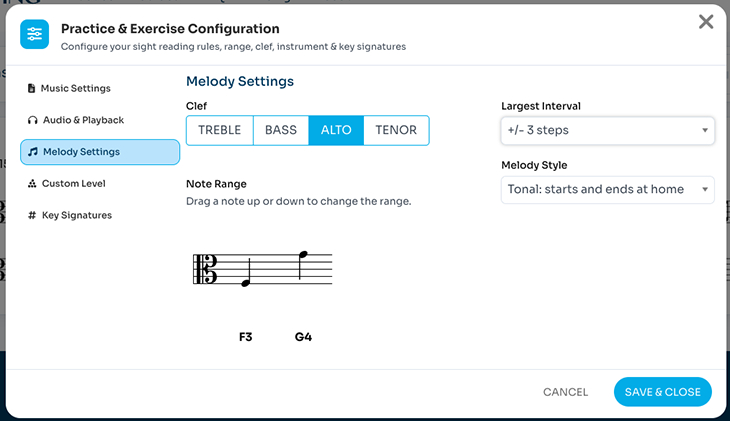
Go to the practice tool, open the settings, and use these for week 1:
Alto clef
- Sheet music type: Melody
- Clef (on the Melody Settings tab): Alto
- Key signature: C major
- Note range (drag the lowest and highest note, or use the arrow keys): lowest F, highest G
Tenor clef
- Sheet music type: Melody
- Clef (on the Melody Settings tab): Tenor
- Key signature: C major
- Note range: lowest D, highest E
Those ranges keep every note on the staff, from the bottom line to the top line. In week 3, widen the range by a step or two at each end to bring in ledger lines. Once that feels steady, try a key signature with one sharp or one flat.
If you haven't set up an account yet, create your free account and start with rhythm. You'll be reading alto or tenor clef melodies within a few sessions.
Alto and tenor clef FAQ
Is alto clef the same as viola clef?
Yes. Alto clef is often called viola clef because the viola uses it as its main clef.
Why do cellists use tenor clef instead of just staying in bass clef?
To avoid ledger lines. When a cello part goes high, writing it in bass clef would need several lines above the staff. Tenor clef keeps those notes on the staff, where they're easier to read.
What's the fastest way to tell alto and tenor clef apart?
Look at which line the center of the clef sits on. Middle line means alto. Second line from the top means tenor.
Do I need to learn alto and tenor clef if I play piano?
Not for most piano music. It helps if you study orchestration, read full scores, or accompany string and low brass players.
Enjoyed This Post?
Read more from the blog and start practicing with unlimited exercises.