
Learn to Practice 5/8 and 7/8 Time Signatures
Odd meters, made from the 2s and 3s you already know
Most musicians spend years reading music in 4/4, 3/4, and 6/8. Then they hit a measure of 5/8 or 7/8 and the floor drops out.
The pulse feels lopsided. Counting to five or seven doesn't help. The metronome clicks feel like they're in the wrong place. Here's the thing: odd meters aren't random. Every bar of 5/8 or 7/8 is built from the same two building blocks you already know: groups of two eighth notes (like a beat in 2/4) and groups of three eighth notes (like a beat in 6/8). Once you hear 5/8 as two unequal beats instead of five identical ones, the lopsided feeling becomes a groove. If you're still building confidence in standard time signatures like 4/4 and 6/8, start with our beginner's guide first. Odd meters go much smoother once simple and compound time feel natural.
Every Odd Meter Is Just 2s and 3s
This is the single most important idea for reading asymmetric time signatures. Don't count individual eighth notes. Count the groups.
A measure of 5/8 contains five eighth notes, but you feel it as two beats of unequal length. One beat is a group of two eighths (a quarter note's worth). The other is a group of three eighths (a dotted quarter note's worth). Depending on the order, you get:
- 2 + 3: short-long. Count it "1 2 1 2 3."
- 3 + 2: long-short. Count it "1 2 3 1 2."
A measure of 7/8 has seven eighth notes, but you feel it as three beats: two short beats (groups of 2) and one long beat (group of 3), arranged in different orders:
- 2 + 2 + 3: short-short-long. Count it "1 2 1 2 1 2 3."
- 2 + 3 + 2: short-long-short. Count it "1 2 1 2 3 1 2."
- 3 + 2 + 2: long-short-short. Count it "1 2 3 1 2 1 2."
The bold "1" marks the start of each group. That's where the accent falls. Those accents are what make each grouping sound different from the others, even though they all add up to the same total.
This isn't a modern trick. Balkan and Eastern Mediterranean folk musicians have been playing in these meters for centuries. Bulgarian folk dances map directly to specific odd groupings. The dancers' feet follow the short-long pattern without anyone counting to seven. The 7/8 grouping 2+2+3 is the rhythm of the Rachenitsa, one of Bulgaria's national dances. Béla Bartók borrowed these rhythms for his concert music after collecting and transcribing folk melodies across the region.
Starting With 5/8
5/8 is the best entry point because it only has two groups. You're tracking one switch between short and long, which is manageable even when the meter is brand new to you.
Step 1: Clap the Groups Before You Read
Pick one grouping. Let's start with 5/8 (2 + 3).
Without any notation in front of you, clap and count:
1 2 1 2 3 | 1 2 1 2 3 | 1 2 1 2 3 |
Accent the start of each group. The first clap is louder. The second "1" (on beat 3) is also louder. Everything else is lighter. Loop this until the pattern doesn't require conscious effort. Then switch to 5/8 (3 + 2):
1 2 3 1 2 | 1 2 3 1 2 | 1 2 3 1 2 |
Notice how different they feel. Same five eighth notes. Different groove entirely. The 2 + 3 pattern pushes forward into the longer group. The 3 + 2 pattern settles back after the long group passes.
Step 2: Read Eighth Notes in 5/8
Open Practice Sight Reading's free rhythm exercises and set the time signature to 5/8 (2 + 3) and Level 1, rhythm only. At Level 1 in these meters, you'll see basic note values that map to the beat groups. Quarter notes fill the "2" groups. Dotted quarters fill the "3" groups. Eighth notes subdivide them.
Set the tempo slow. Somewhere around 60-80 BPM for the eighth note pulse. Tap the rhythm along with the audio playback. Focus on where each group starts.
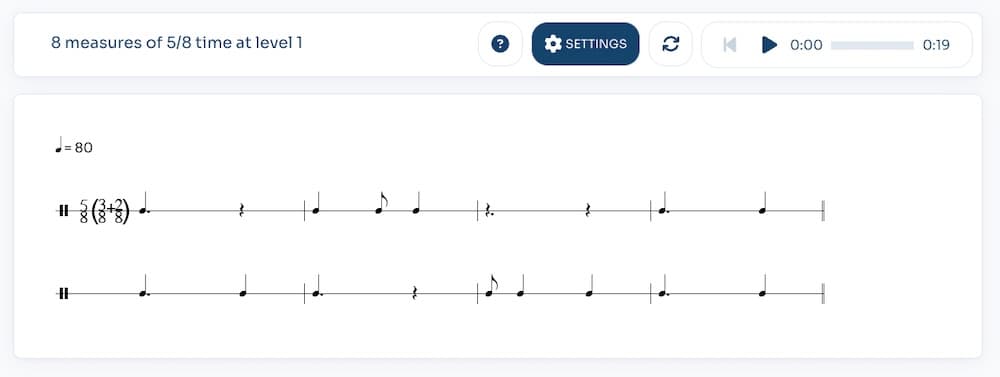
Once you can read Level 1 exercises without losing the pulse, switch to 5/8 (3 + 2) and repeat. The same note values appear, but the grouping flips. Your eyes will want to read it the old way. Resist that. Let the new accent pattern settle in.
Step 3: Add Complexity Gradually
When both 5/8 groupings feel stable at Level 1, move up. Level 2 adds eighth-note pairs, rests on individual eighth notes, and other subdivisions that break up the groups. This is where reading gets interesting. A rest on the downbeat of a group forces you to keep the pulse internally. An eighth note followed by a quarter in a 3-group asks you to hear where that quarter falls. Is it still inside the group, or crossing into the next one?
Don't rush past this stage. Odd meters reward patience more than regular ones do. A shaky foundation in simple 5/8 patterns turns into a total breakdown when sixteenth notes arrive in later levels.
Moving to 7/8
Once 5/8 feels comfortable, 7/8 is a natural next step. You're adding one more group to the bar, which means one more accent to track.
The Three Groupings
7/8 has three standard groupings. Each one has a different character:
2 + 2 + 3 places the long group at the end. It feels like the bar stretches at the finish, then snaps back to one. This is the most common grouping in Western music. The bridge of Rush's "Tom Sawyer" uses 7/8, and many progressive rock riffs land in this pattern.
2 + 3 + 2 puts the long group in the middle. The bar breathes in the center and pinches at both ends. It's less common but creates a rolling feel, almost like a slow limp.
3 + 2 + 2 leads with the long group. The bar opens wide, then hurries through two short groups. This reversal of 2+2+3 pops up in Balkan folk music and gives the meter a completely different momentum.
Practicing 7/8 With the Same Approach
Clap each grouping without notation first. Loop it until it's automatic. Then open Practice Sight Reading.
Set the time signature to 7/8 (2 + 2 + 3), Level 1, rhythm only. Start slow. Read through a few exercises focusing on how the notes fill each group. A quarter note occupies a whole "2" group. A dotted quarter fills a whole "3" group. Three eighth notes subdivide a "3" group into its individual pulses.
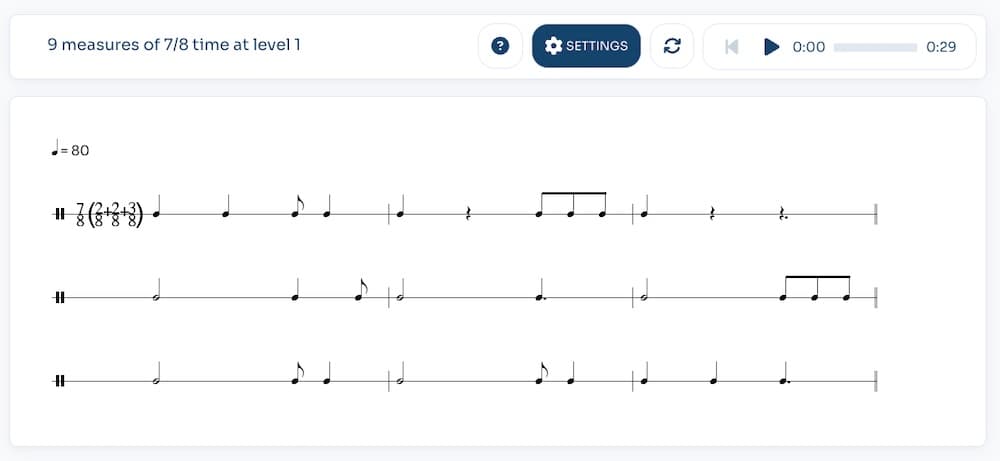
After you're solid in 2 + 2 + 3, switch to the other two groupings. Each one rearranges the same pieces, but the reading challenge changes because your eyes need to find the group boundaries in different places.
Move to Level 2 when you can read Level 1 in all three groupings without losing the pulse. The difficulty progression works the same way as in 5/8: more subdivisions, rests that interrupt the flow, and combinations that cross group boundaries.
How Beaming Shows the Groups
One practical skill that makes odd meters readable: learn to trust the beaming.
In well-notated music, eighth notes are beamed together according to their beat group. In 5/8 (2 + 3), you'll see two beamed eighths followed by three beamed eighths. In 7/8 (2 + 2 + 3), you'll see two groups of two beamed eighths, then a group of three. Practice Sight Reading beams notes this way, and so does most published sheet music in these meters.
You should always look ahead when sight reading. When you do, the beaming tells you where the groups are before you process individual notes. Two connected notes? That's a "2" group. Three connected notes? That's a "3" group. This visual shortcut becomes automatic with practice.
Common Problems and How to Fix Them
The "3" group rushes. This is the most common issue. When you've been playing groups of two, the three-group wants to squeeze into the same space. Slow the tempo down until the three-group feels wide and even. Each eighth note in the "3" group lasts exactly as long as each eighth note in the "2" group. The group is longer because it has more notes, not because the notes are faster.
You lose track of which group you're in. Simplify. Stop reading notation and go back to clapping just the group downbeats. In 7/8 (2 + 2 + 3), that means clapping only on beats 1, 3, and 5. Once those anchor points feel secure, layer the subdivisions back in.
One grouping is fine, but switching to another trips you up. This is normal. Each grouping is its own pattern to internalize. Don't mix them in the same practice session until you can do each one individually. Practice Sight Reading lets you select a specific grouping, so use that to isolate one at a time.
It falls apart at higher levels. Go back to the previous level in the same time signature. The patterns at higher levels assume the basic pulse is automatic. If it's not, adding sixteenth notes or syncopation will overwhelm the system. There's no shame in choosing easier material for a harder meter.
A Practice Plan for Your First Two Weeks
- Days 1-3: Clap 5/8 (2 + 3) and 5/8 (3 + 2) without notation, 2-3 minutes each. Then read Level 1 exercises in 5/8 (2 + 3) in Practice Sight Reading at a slow tempo, rhythm only. Five minutes total.
- Days 4-7: Read Level 1 in both 5/8 groupings. Alternate between them every few exercises. If Level 1 feels solid, try Level 2 in your stronger grouping.
- Days 8-10: Introduce 7/8 (2 + 2 + 3). Clap first, then read Level 1. Keep doing 5/8 practice alongside it.
- Days 11-14: Add the other two 7/8 groupings one at a time. Stay at Level 1 in 7/8 until all three groupings feel stable. Push 5/8 to Level 2 if you haven't already.
This is a rough framework. Adjust based on how quickly the patterns lock in. Some musicians internalize 5/8 in a day. Others need a week. Both are fine.
Where You'll Hear These Meters
Odd meters are everywhere once you start listening for them. Beyond the Balkan folk tradition that gave us these rhythms, they show up across genres:
Progressive rock and metal use 7/8 and 5/8 as riff foundations. Tool's music frequently shifts between odd meters. The bridge of Rush's "Tom Sawyer" sits in 7/8. Genesis wrote entire sections in 7/8 throughout their catalog.
Jazz has explored odd meters since Dave Brubeck's Time Out album in 1959. While "Take Five" is in 5/4 rather than 5/8, the underlying grouping of 3 + 2 is the same concept at a slower tempo.
Film and game scores use asymmetric meters to create tension or unfamiliarity. If a scene feels slightly off-kilter, the composer may be writing in 5/8 or 7/8.
Classical music from the 20th century onward draws heavily on these meters. Bartók, Stravinsky, and their successors brought odd meters from folk music into the concert hall.
Listening to music in these meters, even casually, trains your ear to expect the uneven pulse. That ear training feeds directly back into your reading ability.
Two Beats or Three Beats. That's All It Is.
Odd time signatures are not as exotic as they look on the page. Every bar of 5/8 is two beats. Every bar of 7/8 is three beats. The beats are just unequal, and the notation tells you exactly how they're divided.
Create a free account and try a few exercises in 5/8 or 7/8. Set it to Level 1, rhythm only, pick a grouping, and start slow. The pattern clicks faster than you'd expect.
Enjoyed This Post?
Read more from the blog and start practicing with unlimited exercises.